
How NFC tap technology turns happy customers into bookings
13 November 2026 · 10 min read
How NFC tap technology turns happy customers into bookings
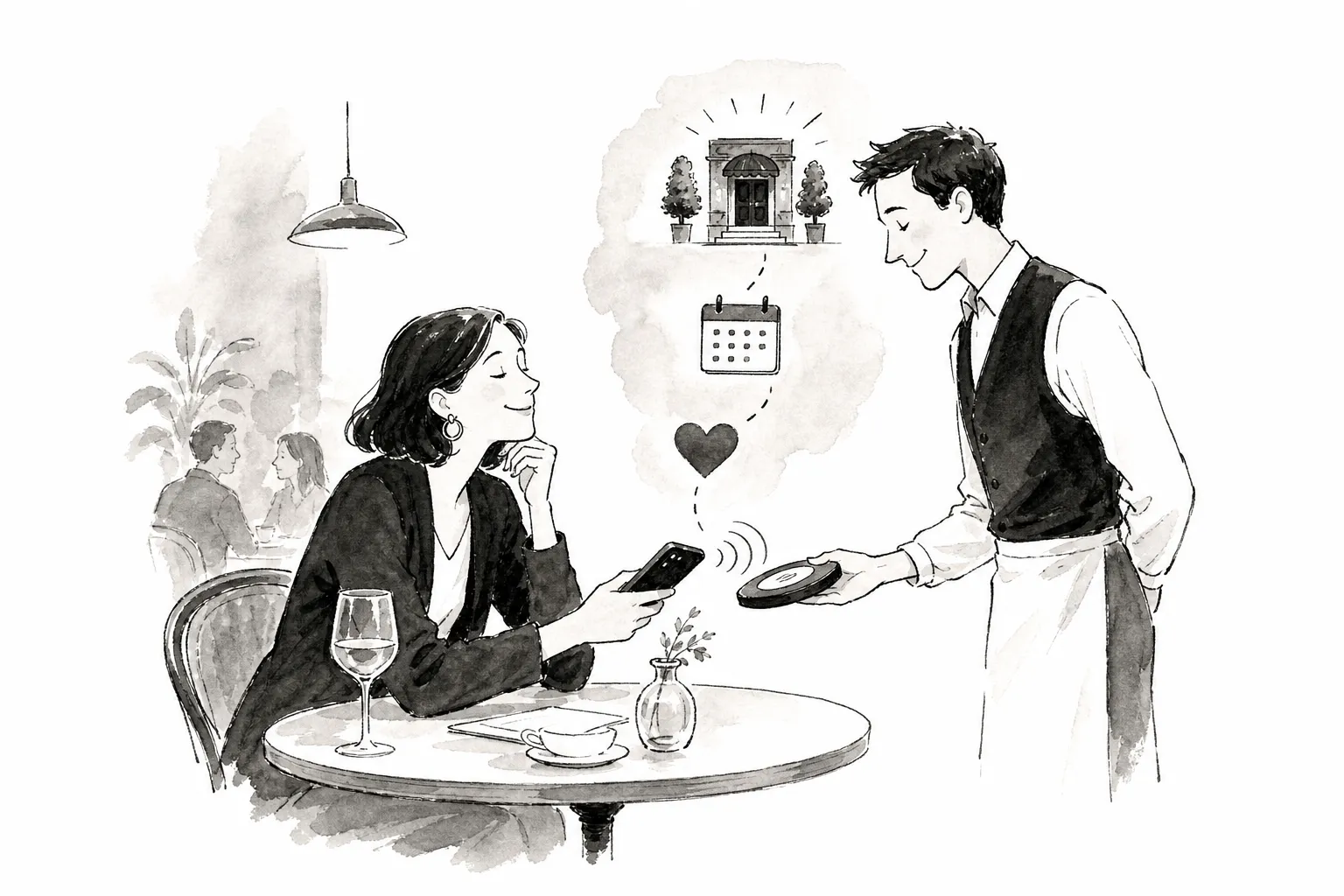
How can you use NFC technology to get more bookings for your business? The answer is simpler than most business owners expect. An NFC tap stand stores a booking link in a small chip. When a customer holds their phone to it, their browser opens a live booking page instantly, no app download or pairing required. This guide explains how to use NFC technology to get more bookings for your business by turning in-person customer moments into instant reservations, covering how the technology works in practice, where to place tap points for maximum impact, what the customer journey looks like after a tap, and how to measure real booking uplift.
Powerful Reviews provides plug-and-play tap stands and booking link cards that require no technical knowledge to use. By the end, you will have a clear picture of how to put this in place and start converting satisfied customers into confirmed bookings.
Key takeaways
NFC tap means instant booking: A tap opens a live booking page in the customer's browser within seconds, with no app or account required.
Timing is everything: Capturing the booking impulse at the peak moment of satisfaction converts far better than a follow-up email sent hours later.
Placement drives performance: Reception desks, waiting areas, and menus are consistently high-converting locations for tap points.
Match the tag to the service: Each NFC point should link directly to the relevant booking page, not a generic homepage.
Track every placement separately: Individual tracked links per stand or card reveal which placements generate bookings and which need adjustment.
Hardware is accessible: Entry-level NFC stickers start at around £0.48 each, while purpose-built tap stands cost around £34.54, according to NFC World.
How does NFC tap technology actually work?
An NFC chip stores a short URL. When a customer's phone comes within a few centimetres, it reads that URL and opens it directly in the browser. There is no app installation, no Bluetooth pairing, and no Wi-Fi connection required from the tag itself. The chip is entirely passive: it has no battery and no moving parts, which means nothing to charge, maintain, or replace.
For a local business, this translates to an effortless customer action. The phone does all the work, and the customer is on a live booking page within seconds of tapping. Many UK consumers are already accustomed to tapping for contactless payments, which helps lower the learning curve for NFC interactions considerably.
What the hardware looks like for a local business
The most practical formats for local businesses are counter-top tap stands, booking link cards for tables or waiting room seats, and sticker-backed tags for menus or printed materials, the same contactless marketing approach that NFC business cards and smart posters NFC campaigns have made familiar in other sectors. Hardware costs are accessible at every level: plain NTAG213 stickers start at around £0.48 each, purpose-built NFC review displays come in at around £34.54 each, and custom review cards start from approximately £13.28 each, according to NFC World. Start with whichever format suits your highest-footfall location and test from there.
Why a redirect URL matters more than the tag itself
The smartest setup stores a short URL on your own domain, such as yourbusiness.com/book, rather than encoding a long booking platform link directly onto the chip. If you change booking platform or update your service page, you update the redirect on your server, and every physical tag already in use continues to work without reprogramming. Powerful Reviews' booking link cards use managed tracked links.
Why does the moment of satisfaction matter so much for conversions?
A customer who has just enjoyed a meal, finished a treatment, or left a successful appointment is at the highest point of motivation to rebook. That window is short. By the time a follow-up email arrives hours later, the feeling has cooled and the intent to act along with it. The timing and channel you use determine whether that motivation becomes a confirmed booking.
The gap between intent and follow-through
When businesses rely on email sequences, open rates drop, links get buried, and the ask feels disconnected from the original experience. The customer has mentally moved on. An NFC tap point at the moment of checkout or the end of a service catches them while their phone is already in hand and while the positive feeling is still present, removing every step between motivation and action.
In-person capture versus digital follow-up
A UK out-of-home trial reported by The Media Leader recorded a 24% content conversion rate from NFC and QR interactions when the prompt was immediate and in-person. A separate UK retail pilot found that 92% of customers who engaged in-store used the discount code they received, according to 2way. These figures are not tap-to-book rates specifically, but they demonstrate how dramatically in-person, in-the-moment prompts outperform passive follow-ups when the action is simple and the motivation is live.
How can I use NFC technology to get more bookings: where to place your tap points
Placement is the single biggest variable in whether a tap point generates bookings or gets ignored. The rule is straightforward: position tags where customers are already attentive, physically close, and have their phone accessible, and the zones below are where NFC reservations happen most reliably.
Reception desks and checkout counters
Reception desks and checkout counters are often high-converting in many service businesses, making them a strong first placement to test. The staff interaction has just ended, the customer is at ease, and their phone is either in their hand or their pocket. A tap stand on the counter, angled toward the customer, with "Tap to book your next visit" printed clearly, requires no staff prompt at all. The customer sees it, taps, and is on the booking page before they reach the door.
Where to place NFC tap points to get more bookings: waiting areas and service rooms
Waiting areas offer high dwell time and low anxiety, making them ideal for a booking card left on a seat or side table. Customers are looking for something to do, and a card inviting them to book their next appointment is a natural fit. In treatment rooms or consulting chairs, a booking link card on the armrest positions the rebooking action before the customer has even stood up to leave, capturing intent at its peak rather than chasing it afterwards.
Menus, tables, and product displays
A tap card embedded in a menu holder or placed beside a product display creates contextual relevance that a generic stand cannot match. If a spa treatment menu has a tap-to-book card beside each service description, the customer can move from discovery to reservation in a single tap. The same logic applies to a retail shelf, a product display, or a restaurant table: the tag should sit next to whatever inspired the booking impulse in the first place. This is particularly effective in NFC for hospitality settings, where the moment of enjoyment and the moment of decision naturally coincide.
What should happen after a customer taps?
The tap is worthless if the page it opens creates friction. A booking page that is slow to load, requires account creation before showing availability, or opens to a generic homepage will lose most of the conversions the tap generates. The post-tap experience is where bookings are won or lost.
Choosing the right booking destination
The destination should always be a service-specific booking page, not a homepage. Platforms including Square Appointments, Acuity Scheduling, Fresha, Calendly, and Vagaro all support direct booking URLs suitable for NFC delivery. The key is matching each tag to its context: a tag on the massage menu should open the massage booking page, not a list of all services.
Platform Best fit NFC suitability Square Appointments Salons, local services, payment-integrated businesses Direct booking links and mobile-optimised pages Acuity Scheduling Branded booking pages, multiple service types Service-specific links and embeddable booking bars Fresha Beauty and wellness, repeat bookings Provider and service booking profiles Calendly Consultations, one-to-one meetings Event-type links open directly in mobile browser Vagaro Spas, salons, wellness businesses Service or staff-specific booking pages
What the landing page must do in the first five seconds
The booking CTA must be visible above the fold without scrolling. Real availability should appear immediately, with no account creation required before slot selection. The page must be mobile-first in design and fast to load. Trust signals near the final step, a review snippet, a clear service description, or a cancellation policy, reduce hesitation at the point of commitment.
CTA copy structure matters significantly. Benefit-plus-action phrasing consistently outperforms vague labels. "Tap to book your next appointment" or "Tap to choose a time" gives the customer a clear outcome before they commit to the action. "Learn more" or "Contact us" does not, and hesitation at this stage costs bookings. Keep the label short, specific to the service where possible, and free of false urgency.
How do you know which tap placements are working?
Tracking is what separates a guessed placement from a proven one. Without individual data per placement, you cannot tell whether the reception desk tap stand is generating five bookings a week while the waiting room card sits untouched. Both look identical from the outside; only tracked links reveal the difference.
Giving each placement its own tracked link
The practical method is using unique redirect URLs or UTM parameters per stand or card, for example, appending parameters such as utm_medium=tap and utm_campaign=reception-desk to each destination URL. Powerful Reviews' client portal assigns individual tracked links to each stand and card, so you can see at a glance which placements are generating taps and which are not pulling their weight. This removes the need to manage separate analytics setups or pull data manually across multiple locations.
What to measure beyond the tap count
The full funnel runs from tag taps through to landing page loads, booking starts, slot selections, and completed reservations. Optimising for completed bookings per tap, rather than raw tap volume, is the metric that actually matters. A compelling but misleading CTA may generate plenty of taps while producing poor booking completion, something raw tap data alone would never reveal. Monthly insight reports, such as those produced by Powerful Reviews, record baseline numbers at launch and show growth week over week, so you always know what is improving and what needs adjustment without manual data retrieval.
Getting started: the simplest path to your first tap-to-book result
The minimum viable setup is one NFC tap stand at the reception desk, linked to your most popular service booking page, with "Tap to book your next visit" copy visible to the customer. No technical background is required. Powerful Reviews' tap stands include managed tracked links.
Using NFC tap technology to get more bookings for your business does not require an app, a developer, or a complex campaign. It requires a well-considered physical placement, a frictionless booking page, and a tracking system that shows what is working. The businesses winning on direct bookings right now are the ones who made it effortless to say yes in person, while the motivation is still fresh.
To put tap-to-book in place for your business, get in touch with our team to find out which placements and hardware formats will work hardest for your location.
Frequently Asked Questions
Do customers need to download an app or pair their phone to use a tap stand?
No, customers do not need an app or pairing; a tap opens a live booking page directly in their browser. The NFC chip stores a short URL the phone reads within a few centimetres, so there is no app installation, Bluetooth pairing, or Wi‑Fi requirement from the tag itself.
Do NFC tags require charging or ongoing maintenance?
No, NFC chips are passive and have no battery, so they require no charging or regular maintenance. The chip simply stores a URL and the customer's phone does all the work when it comes into range.
How quickly will we know which tap placements are working?
You can see performance quickly by assigning individual tracked links to each stand or card and reviewing the tracked data. Monthly insight reports record baseline numbers at launch and show week‑over‑week growth, and our client portal displays which placements are generating taps so you can adjust without manual data pulling.
Want more reviews like this?
See how Powerful Reviews turns happy moments into Google reviews and social follows in a free 30-minute demo.
Book a free demo