
How to increase direct bookings for your small business
2 November 2026 · 12 min read
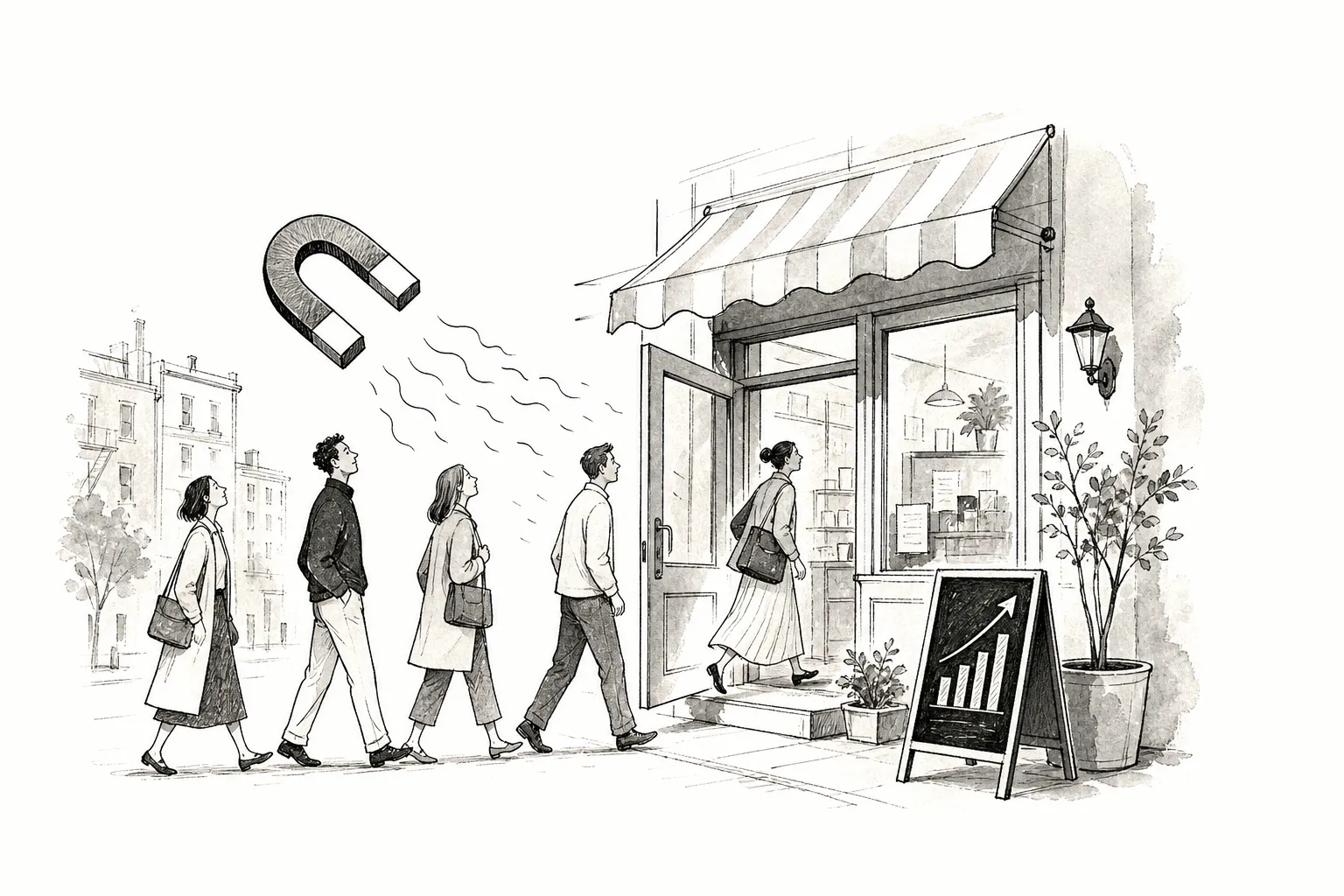
How to increase direct bookings for your small business
To increase direct bookings for your small business, focus on five areas: your website booking flow, your Google Business Profile, a clear direct-booking incentive, in-person capture at the moment of satisfaction, and a structured follow-up sequence for anyone who starts a booking but doesn't finish it. Each area removes a specific friction point between a willing customer and a confirmed appointment or reservation. You don't need to tackle all five at once. Choose three, set a baseline on day one, and measure weekly. This guide gives you the practical tactics to do exactly that.
Every booking placed through an OTA or third-party platform costs you a commission and hands the customer relationship to someone else. When a guest books direct, you keep the margin, you hold the contact details, and you control what happens next. That difference compounds over time, which is why a direct-booking strategy is one of the highest-return investments a small business owner can make. Tools like Powerful Reviews are already helping local businesses capture bookings at the exact moment a customer is most likely to act, more on that shortly.
Key takeaways
Website flow first: A prominent "Book now" button above the fold, with transparent pricing and mobile-first design, is the single highest-impact website change you can make.
Google Business Profile: A complete, well-reviewed profile drives free booking traffic and can include a direct link that bypasses any third-party platform entirely.
Specific incentives convert best: A clear, low-cost perk such as a free upgrade or flexible cancellation outperforms a vague discount in most small-business settings.
In-person capture is underused: NFC tap stands placed at checkout or reception help turn satisfied walk-in customers into future bookings with minimal staff effort.
Recover abandoned bookings: A three-email sequence over 72 hours re-engages visitors who started but didn't finish, at no additional ad spend.
Track three KPIs: Direct booking conversion rate, cost per direct booking, and share of bookings from direct versus third-party channels tell you what's working within weeks.
Does your website booking flow actually convert?
The most common reason small businesses lose direct reservations has nothing to do with price or reputation. It's that the booking process itself is too slow, too long, or buried three clicks from the homepage. Many visitors form an impression quickly and will abandon slow or unclear booking flows, so speed and simplicity are primary conversion factors worth addressing before anything else.
Put the booking action where visitors land first
A prominent "Book now" or "Check availability" button above the fold, visible before any scrolling, is the single highest-impact change for booking engine optimisation. Place that button on your homepage, each service page, and your contact page. On mobile, large tap targets and minimal form fields are non-negotiable: a slow or cluttered booking experience will undermine even the most compelling offer before it gets a chance to work.
Show pricing, terms, and social proof before checkout
Display the total price, including any deposits or fees, alongside your cancellation policy and availability early in the booking flow, rather than at the final step. Transparent pricing reduces the hesitation that causes drop-off. Place review scores and trust signals directly beside the booking form, not just on a separate testimonials page: proof is most effective when it sits at the exact point where a visitor is deciding whether to commit.
How your Google Business Profile drives free booking traffic for small businesses
A well-maintained Google Business Profile is one of the most cost-effective direct channel marketing tools available to any small business looking to increase direct bookings. It surfaces your business in local search results and Google Maps at the precise moment someone is actively searching for what you offer, and it costs nothing to maintain.
Completing your profile is a free conversion tool
A complete profile includes an accurate business category, up-to-date opening hours, quality photos, detailed service descriptions, a website link, and a direct booking link where your booking engine supports it. Google uses profile completeness and engagement as ranking signals, so an incomplete profile actively works against your visibility. You may be able to add a booking link by signing into your profile, selecting "Booking" in Google Search or "Edit profile" in Maps, and pasting your booking page URL directly, which can reduce OTA commissions by routing customers straight to your own booking page. Note that the availability of a dedicated "Book" action depends on your business category and eligible providers; if it is not available for your category, adding your booking URL via the "Website" field is a practical alternative.
How reviews on your profile convert researchers into bookers
Star rating and review recency are the two factors that most influence whether someone clicks through or scrolls past your listing. A healthy volume of recent reviews builds the local search visibility that brings people to your profile in the first place, then converts those researchers into bookers once they arrive. Generating reviews consistently is just as important as getting the booking link right. The most reliable way to do that is to capture them passively, at the moment a customer is most satisfied.
What direct-booking incentives actually convert?
Increasing direct bookings for small businesses is often more about the right incentive than a larger discount. The most effective offers are specific, low-cost perks that feel genuinely valuable. Clarity beats complexity: a simple offer visible beside every booking button outperforms a vague "exclusive member benefits" message every time.
Perks that cost little but feel valuable
The incentive types with the strongest conversion tend to be: a complimentary room or service upgrade when spare capacity allows, a free add-on such as breakfast or a follow-up treatment, flexible cancellation terms, and returning-customer promo codes. Flexible terms often outperform price cuts outright, particularly when customers are uncertain about their plans. Bundle packages, for example, a treatment plus a follow-up appointment, differentiate the direct offer without requiring any rate reduction.
How to frame your offer so it stands out
Place the direct-booking benefit visibly alongside every call to action, rather than burying it on a separate promotions page. A practical example: "Book direct: free upgrade + flexible cancellation" consistently performs better than a percentage figure that requires mental calculation. Test one perk at a time and track net revenue alongside conversion rate, because the winning offer is the one that produces the highest net contribution, not simply the most clicks.
How to increase direct bookings for your small business through in-person capture
Most small businesses focus their direct booking strategy entirely online while ignoring the most powerful moment they already have: a satisfied customer standing right in front of them. Walk-ins who leave happy represent a direct-reservation opportunity that requires no ad spend and no follow-up staff effort.
The in-person moment your booking strategy is missing
A customer finishes a great haircut, meal, or treatment, fully intends to book again, and then life gets in the way. By the time they search online a few days later, they may land on a third-party platform instead of your own booking page. A physical touchpoint at the point of service bridges that gap while satisfaction is still at its peak, without requiring any awkward request from your team.
A single tap from happy customer to confirmed appointment
NFC tap technology makes this genuinely frictionless. A customer holds their phone near a small branded stand on the reception desk or treatment table and lands directly on your booking page, no app, no searching, no staff prompt required. At Powerful Reviews, we provide tap stands and QR codes that link directly to a booking page, review profile, social page, or WhatsApp group, with every tap tracked individually in a client dashboard and captured in monthly insight reports. For salons, clinics, restaurants, and any service business with regular footfall, this is a set-and-forget way to materially increase the likelihood that satisfied visitors will book again, with minimal staff effort.
The email sequence that recovers abandoned bookings
A significant share of visitors who start a booking process don't complete it. A structured follow-up sequence, starting within the hour, recovers a meaningful portion of that lost revenue without any additional ad spend.
The three-email structure that re-engages within 72 hours
The proven three-email sequence works as follows: an initial reminder at 30 to 60 minutes containing the exact details the customer was viewing and a one-click resume link; a second email at 24 hours that addresses likely objections, such as cancellation policy, fees, and book-direct benefits; and a third email at 48 to 72 hours with a genuine urgency signal or a small value-add if needed. Each email should be additive rather than repetitive: a reminder, then an objection handler, then urgency. Repeating the same message across all three underperforms a progressive sequence.
When to add SMS to your abandoned-booking flow
A single SMS at the 24-hour mark works well for opted-in contacts, particularly for imminent bookings or higher-value services. Keep it short, identify your business clearly, and include an opt-out instruction. Suppressing the entire sequence the moment a booking is completed is just as important as sending it: nobody should receive a follow-up after they've already confirmed.
Your 30-day plan and the KPIs that show it's working
Implementing everything at once produces nothing measurable. Choose three to five tactics from this guide, set a baseline on day one, and review your numbers every week. Incremental improvements across multiple touchpoints add up quickly when you can see which ones are moving.
Three metrics to track from day one
Track these three KPIs from the start: direct booking conversion rate (bookings divided by booking-page visitors), cost per direct booking (ad spend plus tool costs divided by completed bookings), and the share of total bookings coming through your direct channel versus third-party platforms. Booking engines such as Square Appointments, Cal.com, and FareHarbor provide the transaction data, while Google Analytics 4 shows the traffic source. Together, those two give you a clear picture of where bookings are coming from and what each one costs you.
Business type Recommended booking engine Why it fits Salon, barber, beauty or wellness Fresha or Square Appointments Supports service menus, staff availability, deposits, and reminders with low setup friction Small gym, yoga or Pilates studio SimplyBook.me or BookWhen Handles group classes, capacity limits, memberships, and waitlists Independent therapist or clinic Acuity Scheduling or Square Appointments Manages individual appointment types, intake forms, and payments cleanly Tour or activity operator FareHarbor or Rezdy Commission-based or subscription pricing with distribution features for variable booking volume Restaurant or hospitality Square or a dedicated reservations widget Integrates with POS and supports direct table or experience bookings
The direct-booking offer to draft this week
Write one clear incentive sentence before anything else: something specific, like "Book direct: complimentary upgrade + free date changes." Then pick one in-person touchpoint to test, whether that's a tap stand at checkout or a QR code on your counter, and set up the first two emails of your abandoned-booking sequence. Those three actions form a minimum viable starting point that most small businesses can implement without a technical team or a large budget.
Start with one section and build from there
Increasing direct bookings for your small business doesn't require a significant budget or a technical overhaul. It requires removing friction at each stage of the customer journey: a clear booking button, a complete Google profile, a specific incentive, a physical touchpoint at the moment of satisfaction, and a structured follow-up for anyone who almost booked but didn't quite get there.
The highest-value tactics are often the most overlooked. Optimising your Google Business Profile costs nothing. Placing a clear incentive beside every booking button is achievable in an afternoon for most websites: craft a benefit sentence, update your call-to-action areas, and test the mobile display. Adding an NFC tap stand at your reception desk can materially increase the likelihood that satisfied visitors will book again, with minimal staff effort. Following up with a three-email sequence recovers bookings that would otherwise be lost to inertia.
Businesses that own their booking relationship own their customer data, their margin, and their growth. Pick one section from this guide, implement it properly, and measure the results. Then add the next. Get in touch with our team if you'd like to explore how tap technology and tracked QR codes can make in-person booking capture a passive part of your daily operation.
Frequently Asked Questions
Which three actions should we implement first to start increasing direct bookings this week?
Implementing a clear direct-booking incentive sentence, one in-person touchpoint (such as an NFC tap stand or QR code), and the first two emails of your abandoned-booking sequence is the recommended starting point. These three actions form a minimum viable start that most small businesses can set up without a technical team or large budget, and they let you begin measuring impact immediately.
How quickly will we see whether these changes are working?
You should set a baseline on day one and measure weekly to see progress. Use the 30-day plan to review numbers across multiple touchpoints and track whether incremental improvements are moving your key metrics.
Do we need a technical team to implement the suggested tactics?
No, most small businesses can implement the minimum set of tactics without a technical team. Writing a single incentive sentence, placing a tap stand or QR code at reception, and enabling the first two emails in an abandoned-booking sequence are all practical actions that can be completed without heavy technical resources.
Are NFC tap stands suitable for every type of small business?
NFC tap stands are particularly effective for salons, clinics, restaurants and any service business with regular footfall where satisfied customers are physically present at the point of service. They offer a low-effort way to convert walk-ins into future bookings by sending customers directly to your booking page, review profile, social page or WhatsApp group.
How do we make sure customers don't receive follow-ups after they've already completed a booking?
You must suppress the follow-up sequence the moment a booking is completed so nobody receives a follow-up after confirmation. This ensures your reminders and messages only target genuinely abandoned bookings and protects the customer experience.
Want more reviews like this?
See how Powerful Reviews turns happy moments into Google reviews and social follows in a free 30-minute demo.
Book a free demo