NFC tap cards vs QR codes: which suits your business?
3 October 2026 · 10 min read
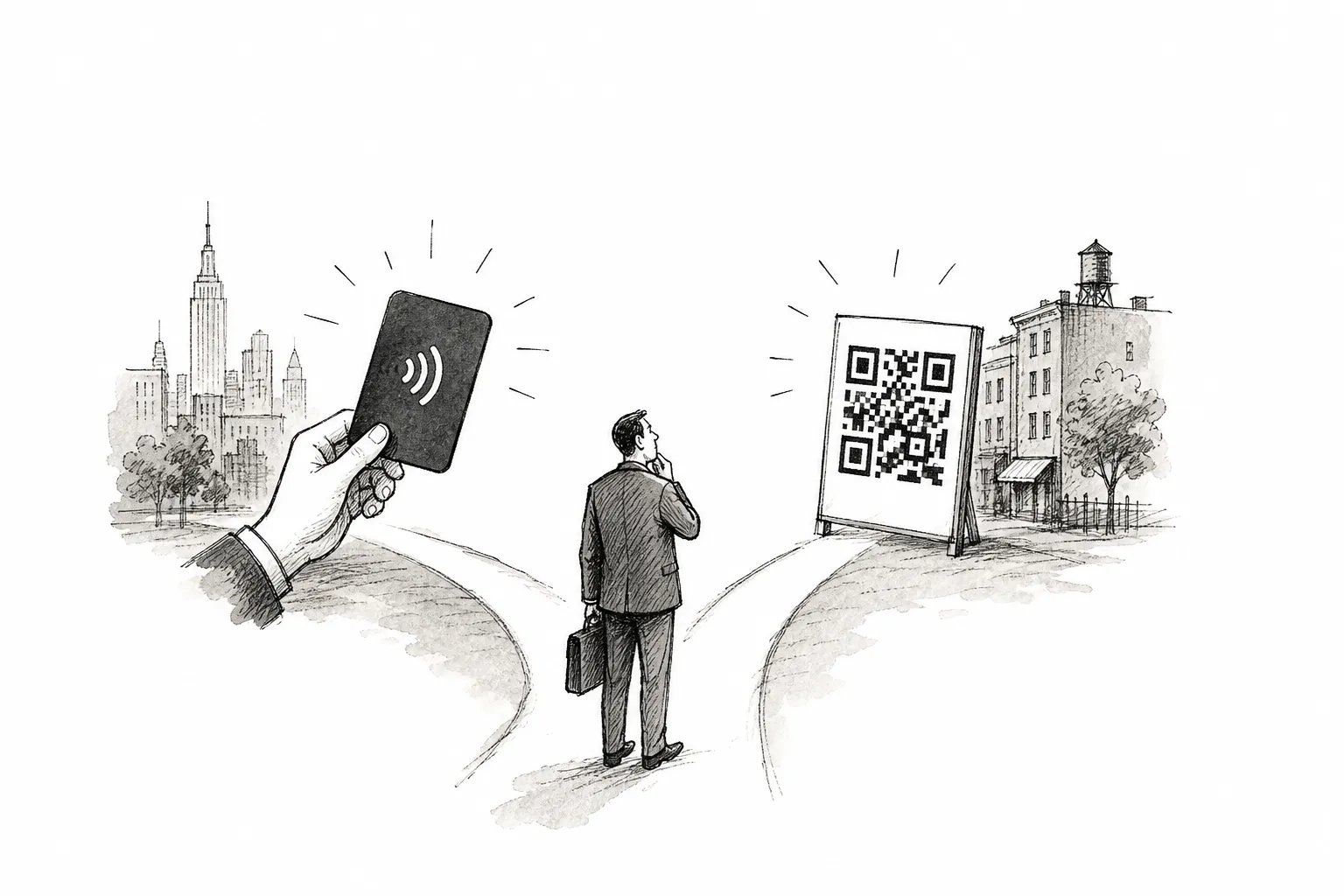
NFC tap cards vs QR codes: which suits your business?
You've seen the tap stands sitting by the till at the coffee shop down the road, and you've seen the QR codes laminated to restaurant menus. Both promise frictionless convenience. Both let customers take action without handing anything over to staff. But they work differently, cost differently, and suit different types of customers, so choosing the wrong one for your setup can mean missed opportunities at the exact moment a happy customer is ready to act. If you're weighing up an NFC tap card vs QR code for small business use, this guide breaks down both options so you can make a genuinely informed decision.
This article covers how each technology actually works, what it costs to get started in the UK, where each one falls short, and which suits which type of business. Tools like Powerful Reviews have moved past the either/or debate by combining both into one managed system, but understanding the fundamentals first will help you make a smarter choice, whether you're starting from scratch or looking to improve what you already have.
NFC tap card vs QR code for small business, how each technology works
Most business owners understand the surface behaviour: customers either tap or scan. What matters more is what happens in the background, because that determines reliability, speed, and the degree of control you have over the experience. Both methods encode a URL and deliver it to a customer's phone; the distinction lies entirely in how that delivery happens.
What happens when a customer taps an NFC card or stand
The NFC chip inside the card or stand transmits a URL to the customer's phone via a short-range radio signal. No app is required on the customer's side; the phone simply receives the signal and opens the destination, whether that's a Google review page, a booking link, or a social media profile, instantly in the browser. The whole interaction takes under two seconds and requires no action from staff whatsoever.
What happens when a customer scans a QR code
The customer opens their camera app, points it at the code, and taps the link that appears on screen. The QR code encodes the same type of URL as an NFC tag; the difference is purely in how the customer accesses it. Static QR codes point to a fixed URL that cannot be changed after printing, while dynamic QR codes can be updated without reprinting and allow scan tracking, making them considerably more useful for business applications.
Ease of use and the real customer experience
Speed and device compatibility are the two factors that matter most in a busy business environment. This is where the two technologies start to diverge in practice, and the gap is more significant than it might first appear.
Speed, friction, and what customers actually do
NFC tap averages under two seconds from touch to destination. QR scans typically take five to ten seconds, sometimes longer in low light, on older camera apps, or when the code is poorly placed or printed too small. In high-footfall environments, café checkouts, salon desks, and busy retail tills, that friction difference has a real impact on how many customers follow through.
NFC requires zero extra steps: no camera app to open, no code to centre in frame, no waiting for the link to appear. QR codes can also fail for reasons that have nothing to do with the technology itself: damaged print, glare from a shiny surface, weak indoor connectivity, or a slow-loading webpage can all break the journey before the customer reaches your review page.
Device compatibility across the UK customer base
Approximately 90% of UK smartphones support NFC natively, but NFC can be disabled in settings or absent from budget Android models. QR scanning works on roughly 98% of UK smartphones via the native camera app, making it the more universally accessible option. For businesses in areas with older or more budget-conscious customer demographics, QR codes carry less risk of leaving someone unable to participate, worth factoring into your decision when comparing an NFC tap card vs QR code for small business use.
Setup costs: NFC tap card vs QR code for small business
Neither technology requires significant investment, but the cost structure is different enough to influence which makes sense depending on your budget and how often you need to update your links.
What NFC cards and stands actually cost
NFC cards and stickers range from roughly 30p to £3 each in small quantities, with no recurring cost once programmed if you manage the links yourself. Platform-based NFC review tools generally cost between £5 and £50 per month depending on features such as analytics, multiple locations, and individually tracked links. A realistic first-year budget for a basic NFC review setup comes to approximately £90 to £280, including cards, stands, and software, which for most small businesses is an entirely manageable starting point.
QR code costs from print to platform
A static QR code pointing to a fixed URL costs virtually nothing to generate and only needs printing; a simple A5 table card can be produced for under £5. Dynamic QR code software, which allows you to change the destination URL and track scans, typically runs £5 to £30 per month. Year-one costs for a QR review or menu system range from around £30 to £510, depending on whether you use a hosted platform or a simple printed code. The lower end of that range is very accessible, but a static QR code with no tracking gives you no data on what is actually working.
Security and reliability in the real world
Both methods are safe when set up correctly, but they have different vulnerability profiles that are worth understanding, particularly for businesses where the technology is left unattended in public areas.
Where NFC has the stronger security baseline
For payment applications, NFC transactions that use tokenisation and one-time cryptographic exchanges are resistant to replay attacks, meaning a captured signal cannot simply be reused. For review collection and link delivery, the security risk of NFC is extremely low because no financial data is exchanged at all. Physical tampering with an NFC stand is also much harder than interfering with a QR display: the chip must be physically replaced, not simply covered with a sticker.
QR code risks and how to manage them
The primary risk with QR codes in public settings is code substitution: a fraudulent sticker placed over a legitimate code can redirect customers to a different destination entirely. Static QR codes are also vulnerable to being photographed and redistributed, pointing customers to outdated or compromised pages. Dynamic QR codes with expiry controls and scan monitoring reduce this risk significantly, and a quick visual check of QR signage should sit alongside other routine opening checks.
Which method fits your type of business?
Rather than declaring a winner, the practical answer depends on where your customers interact with you, how your space is laid out, and what action you want them to take.
When NFC tap cards and stands are the stronger choice
Counter-based businesses where customers queue or check out in person benefit most from the sub-two-second NFC experience. Coffee shops, salons, barbers, and retail tills are the obvious candidates. NFC works without any customer instruction: a small sign saying "tap here to leave a review" is usually sufficient, and staff don't need to explain anything or get involved in the process at all.
If your customer base skews towards people who regularly use contactless payment, they are already conditioned to tap behaviour and will find the action completely natural. UK Finance reported that 20% of UK adults use mobile contactless payment every day, and 50% use it at least monthly. That conditioning translates directly to NFC review taps.
When QR codes make more practical sense
Table-service restaurants, outdoor market stalls, pop-up events, and businesses with older or more mixed customer demographics benefit from QR's near-universal device compatibility. QR codes are also the right choice when your budget is tight and you want to test a contactless review strategy before committing to hardware. They work on any surface, menus, receipt footers, window stickers, packaging, and printed signage, which gives you far more placement flexibility than a physical NFC stand.
The case for using both in the same location
Many businesses find that NFC suits their younger, tech-forward customers while QR suits everyone else, and both can point to exactly the same destination. Running both in parallel means no customer is excluded and no opportunity is missed at the moment of satisfaction. The challenge with managing two separate systems is tracking which is performing and where to focus investment, which is exactly where a unified platform removes the headache.
In practice, offering both a tap and a scan covers different device types, age groups, and confidence levels without forcing anyone to choose. A prompt that reads "tap your phone or scan the code to leave a review" covers the full customer base in a single instruction. It's the simplest way to ensure no customer is left out of the moment.
How Powerful Reviews puts both in one managed system
For business owners who don't want to manage two separate tools or guess which method is working, Powerful Reviews is built to handle both from a single dashboard. The either/or question between NFC tap card and QR code becomes irrelevant because both are covered, tracked, and reported on in one place.
One platform running NFC tap and QR code side by side
Powerful Reviews provides physical NFC tap stands and cards alongside QR codes, all linked through individually tracked URLs so every tap and scan is recorded separately. Business owners can place a tap stand at the counter and a QR code on the table, on the receipt, or in the window, all feeding into the same review or social page. There is no app for the customer to install and no technical setup required from the business owner: the hardware arrives ready to use, making it a genuinely set-and-forget system.
The platform covers multiple review and social channels in a single setup, including Google, Tripadvisor, Trustpilot, Facebook, and WhatsApp, among others. Additional tap cards handle WiFi access, booking links, and promotional offers, so the same infrastructure that collects reviews can also drive direct bookings or social follows without any added complexity.
Monthly reports that show what is actually working
The Powerful Reviews client portal records baseline numbers at launch and tracks growth week over week, broken down by tap stand, QR code, location, and destination channel. Business owners with multiple sites can see at a glance which locations are driving the most reviews, which technology their customers prefer, and where there is room to improve. This level of visibility turns contactless review collection into a measurable, repeatable part of the business rather than something left to chance.
The right tool is whichever one your customer will actually use
When weighing up an NFC tap card vs QR code for small business use, the honest answer is that they aren't competing technologies, they're complementary tools that serve different moments and different customers. NFC wins on speed and simplicity at the point of contact. QR wins on accessibility and cost flexibility. The businesses that collect the most reviews tend to be the ones that cover both bases rather than committing to one approach and hoping it works for every customer who walks through the door.
If you want to deploy both without managing two separate systems or piecing together your own tracking solution, Powerful Reviews gives you the hardware, the tracking, and the monthly reporting in one managed setup. Get in touch with our team to find out how it works for your type of business and how quickly you can have both technologies live and collecting results.
Want more reviews like this?
See how Powerful Reviews turns happy moments into Google reviews and social follows in a free 30-minute demo.
Book a free demo