
Restaurant review collection: the methods that actually work
2 November 2026 · 12 min read
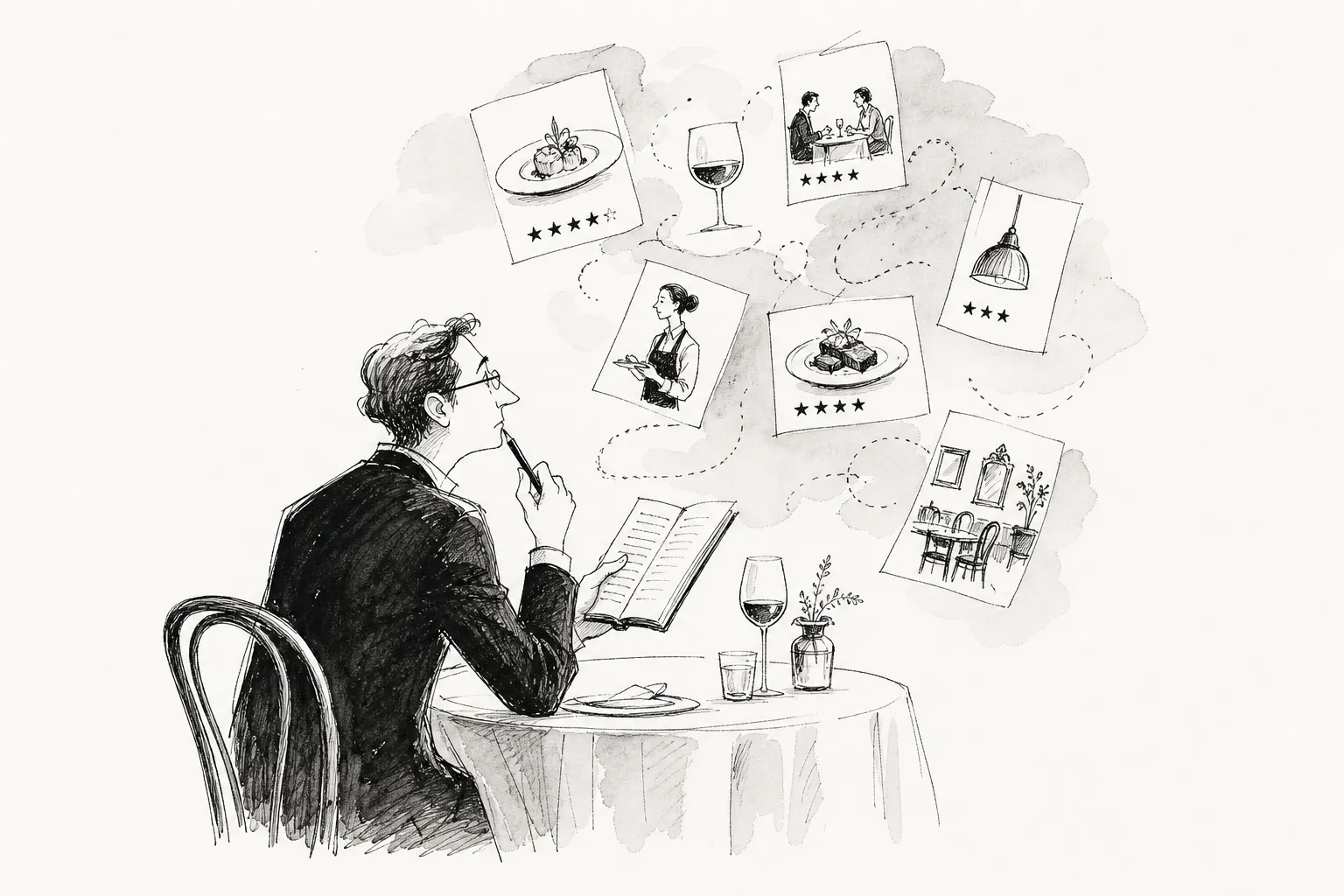
Restaurant review collection: the methods that actually work
The most effective methods for restaurant review collection are in-person capture at the moment of peak satisfaction, followed by a timely follow-up for diners who didn't act on the night. Everything else, hoping guests remember, relying on organic goodwill, or burying a link in a menu footer, works at a fraction of the rate in many deployments. Restaurants that ask at the right moment collect substantially more reviews than those that wait, and the difference between a passive approach and an active one compounds over time, particularly in local search rankings.
This guide covers the two main categories of restaurant review collection: active, in-person collection and post-visit follow-up. We look at at-table tools including NFC tap stands, compare methods using the best available data, and explain what UK compliance requires before you request a single review.
Key takeaways
In-person capture wins: In many tested deployments, prompting diners while they're still seated and satisfied outperforms post-visit methods.
NFC tap removes friction: One tap takes a customer directly to a review page with no scanning, no searching, and no app required.
Follow-up is a supplement: Email and SMS recover diners who didn't act in the moment but should not stand alone as your only strategy.
Timing determines follow-up success: The optimal post-visit window is 24–48 hours, when the experience is still vivid.
UK compliance requires care: Ask all customers honestly using neutral wording, never incentivise positive ratings, disclose any reward given, and consult CMA and ICO guidance for specifics.
GDPR-friendly options exist: In-person tap capture directed to a public platform means your restaurant does not store diners' personal data at that point, though any tap-tracking analytics your system logs may still constitute data processing under UK GDPR.
Why passive restaurant review collection leaves most restaurants short
The gap between a happy diner and a written review
Satisfaction alone rarely translates into action. A diner can finish a genuinely excellent meal, feel warm about your restaurant, and fully intend to leave a review, then forget within minutes of stepping outside. The intention is real; the motivation simply doesn't survive the journey home, a busy evening, and the friction of opening Google, searching your restaurant name, and finding the review button.
Each step between a happy diner and a submitted review is a point where people drop off. Most never make it to the end. That friction is the core problem with passive collection, and no amount of hoping bridges it.
What passive approaches actually get wrong
Passive review collection means a link on your website, a generic sign near the door, or a URL tucked onto a receipt. These approaches fail for two connected reasons: they target the wrong moment and the wrong channel. A customer who has already left is not in the same frame of mind as a diner who just pushed their dessert plate away and said "that was brilliant."
The concept worth holding onto here is the golden window: the period immediately after a positive experience when motivation is at its highest. Passive tools consistently miss it. Active tools are built around it, and the results reflect that gap clearly. The next section covers what those active tools look like in practice.
At-table restaurant review collection: tools that capture diners at the right moment
Table cards, QR codes, and receipt prompts
Printed table cards with a QR code can prompt review action while the diner is still seated. Placed near the bill, they give guests a natural moment to act: the meal is over, the mood is positive, and there is nothing else demanding attention. Receipt QR codes add lightweight, low-cost coverage to every transaction, though they tend to convert at a lower rate than table-level prompts.
Available benchmarks put table tents and table cards at around 8–12% conversion of exposed diners, whilst receipt QR codes typically sit closer to 3–8%, according to data published by Visu Network. That gap reflects the difference in timing: a table card is seen at the height of satisfaction, a receipt is often glanced at once and pocketed. It is worth noting that these figures measure conversion differently across sources, so treat them as directional benchmarks rather than direct comparisons.
How staff can prompt reviews without making it awkward
A well-timed verbal cue from a server is one of the most natural prompts available. When a diner has just complimented the food or the service, a simple, honest response works well: "Thanks so much. If you enjoyed it, an honest Google review genuinely helps us." That wording is also compliant: it does not specify a star rating, implies no reward, and applies the same invitation to everyone.
The limitation is consistency. Not every team member is comfortable asking, and maintaining a specific form of words across every shift takes ongoing effort. In-person tools that work passively, without requiring staff to initiate a conversation, tend to perform more reliably over time because they don't depend on individual confidence levels.
Does a tap-to-review stand actually make a difference?
How NFC tap technology removes the friction entirely
An NFC tap stand works simply: a diner taps their phone on a branded stand at the till or on the table with the bill and is taken directly to a review page. No searching, no scanning, no app. The entire multi-step process collapses into a single gesture that takes under a second. For a diner who is already in a positive frame of mind, that simplicity is the difference between acting and forgetting.
This is precisely what our NFC tap stands at Powerful Reviews are designed to do. Placed at the moment of highest satisfaction, they put a review prompt in front of a diner when motivation is at its peak. The same stand can route customers to Google, Tripadvisor, Facebook, or any other channel the business prioritises, giving multi-platform coverage from one physical touchpoint with no additional hardware required.
Why capturing the moment matters more than any follow-up
A diner who has just enjoyed a meal is the most motivated they will ever be to write something. That motivation fades with every minute that passes after they leave. Vendor field data from Saphek and The Star Company suggests NFC converts at roughly 2–4 times the rate of QR scanning in their reported deployments, though it is important to note these are vendor-field figures measured against differing denominators, taps, impressions, or completed posted reviews, rather than a single standardised study. The explanation is intuitive: tapping is faster and involves fewer decision points than opening a camera app, framing a code, and tapping the resulting link. Some consumer surveys also indicate a meaningful share of diners say they are more likely to leave a review after an email prompt, so the channel that performs best will vary by audience and setting.
Every tap through our client portal is tracked individually, so restaurant owners can see exactly which stands and locations are generating the most reviews. That makes it a measurable system with clear monthly reporting. For a business managing more than one site, that location-level visibility is particularly useful for spotting where review growth is lagging.
Method Reported conversion range Best placement Main limitation NFC tap stand 25–45% (Saphek / The Star Company vendor field tests; denominator: taps to posted reviews) Till, checkout, table with bill Requires NFC-enabled phone QR code table card 8–12% (Visu Network; denominator: exposed diners) Table tent, bill folder Multi-step process, higher drop-off QR code receipt 3–8% (Visu Network; denominator: exposed diners) Printed receipt Diner has often left mentally Post-visit SMS 12–15% (Malou conversion benchmark) 24–48hr follow-up Requires number collection and consent Post-visit email 3–4% (Malou conversion benchmark) Follow-up sequence Low conversion, easy to ignore
Note: conversion denominators differ across sources. Figures are directional benchmarks rather than directly comparable data points.
Follow-up tactics for restaurant review collection
Email and SMS follow-up: timing and wording
Post-visit follow-up is a valuable supplement and works well alongside in-person tools rather than instead of them. As part of a broader customer feedback collection strategy, email and SMS reach diners who didn't act at the table. For SMS, one industry benchmark from Malou reports approximately 12–15% conversion; email sits closer to 3–4% as a conversion benchmark. Neither replaces the value of in-person capture, but both recover reviews from diners who didn't act at the table, which adds up meaningfully over the course of a month.
Timing matters significantly. The optimal window is 24–48 hours after the visit: long enough for the experience to settle, short enough that it remains vivid. Booking platforms such as OpenTable and ResDiary sometimes have built-in review-request flows, which automate this step for restaurants already using those systems and remove another item from the to-do list.
What to avoid in follow-up requests
The most important compliance rule in follow-up is also the most practical: send the same neutral request to all customers, not just the ones you think are satisfied. Screening customers by likely sentiment before sending is non-compliant under CMA guidance, and it skews your review profile over time. A well-timed, neutral message is effective; repeated pressure is discouraged and risks non-compliance. Chasing customers multiple times or asking them to amend a negative review is both ineffective and contrary to CMA guidance.
Follow-up is most powerful when it reinforces an in-person prompt rather than replacing it. A diner who was tapped at the till and then received a polite message the following day is far more likely to complete a review than one who received only an email they half-remember seeing.
UK compliance basics every restaurant owner needs to know
CMA rules on requesting and incentivising reviews
UK restaurants can ask for honest reviews from all customers. What they cannot do is tie a reward to positive sentiment or a specific star rating. Since April 2025, fake reviews and concealed incentivised reviews are banned practices under the Digital Markets, Competition and Consumers Act 2024, according to guidance from the Competition and Markets Authority. The practical rule is this: if you offer an incentive, make it available for honest feedback regardless of the outcome and disclose it clearly.
"Leave five stars and get a free drink" is unlawful. Inviting all recent diners to submit honest feedback with transparent terms is compliant. Wording for any review request, whether in person or digital, should be neutral: something like "Tell us about your visit, positive or negative" keeps you on the right side of CMA guidance. The CMA investigated restaurant-related practices involving discounts for five-star reviews in March 2026, so this is an active enforcement area, not a theoretical one. Consult the CMA and gov.uk resources directly for specifics and any edge cases relevant to your business.
GDPR basics for review collection and follow-up
When restaurants collect contact details to send review requests, they are processing personal data under UK GDPR. The key principles are lawful basis, purpose limitation, and data minimisation. Email or SMS follow-ups require either clear consent or a genuine existing customer relationship, and the purpose for which you originally collected the contact determines how you can use it going forward.
In-person NFC tap capture directed to a public platform like Google means your restaurant does not store diners' personal data at that point. The diner taps, arrives at the Google review page, and any data processed there belongs to the platform. However, if your system logs tap-level analytics, those records may constitute personal data processing on your side. Review your setup against ICO guidance on lawful basis, privacy notices, and record-keeping to confirm your obligations. For straightforward in-person tap capture with no contact-data collection, this remains one of the more GDPR-friendly approaches to gathering restaurant reviews, since it captures the golden window with minimal data-handling obligations on your end.
Build a review base that compounds over time
A robust restaurant review collection strategy has two tiers: in-person capture at the moment of satisfaction, with a timely follow-up for those who didn't act. Neither tier works as well alone as both do together. Building this kind of user-generated review base takes consistency, but the effect compounds. In a competitive local market, review volume and recency both feed into Google's local ranking signals, and sources including Chowly and Pavadotech suggest that appearing in the local 3-pack in a UK city market typically requires upwards of 100 reviews in 2026, with competitive urban areas often demanding considerably more. That number is not reached by hoping customers remember.
The method you choose determines the result. Restaurants building the strongest review profiles in their area are the ones meeting diners at the exact moment they are most willing to act: bill arrived, evening a success, one tap away from leaving a review. Waiting passively is not a strategy; it is simply handing that opportunity to the restaurant down the road.
Our NFC tap stands at Powerful Reviews are built for that moment. Powerful Reviews' NFC tap stands track every tap in a client portal with clear monthly insight reports and work passively once placed. If reviews are holding your restaurant back, get in touch with our team and we can show you how straightforward the solution really is.
Frequently Asked Questions
Do diners need a special phone to use an NFC tap stand?
Yes, diners need an NFC-enabled phone to use an NFC tap stand. Without NFC capability the tap gesture will not work, so the stand is best placed where most guests are likely to have compatible devices.
Do we need customer consent to use an NFC tap stand at the table or till?
You do not need to collect diners' contact details when they tap to reach a public review platform, but you must consider any analytics your system logs as potential data processing under UK GDPR. Check your setup against ICO guidance on lawful basis, privacy notices and record-keeping if your system stores tap-level analytics or other personally identifiable information.
What do we do for diners who don't have an NFC-enabled phone?
Offer alternative at-table options such as printed table cards or QR codes and a verbal prompt from staff, since NFC requires an NFC-enabled phone. Table cards and QR codes capture diners at the right moment, with table tents typically converting around 8–12% of exposed diners and receipt QR codes nearer 3–8% according to cited benchmarks.
Should we use SMS or email for follow-up, and when should we send it?
Use SMS or email as a supplement to in-person capture and send follow-ups within 24–48 hours after the visit for best effect. Industry benchmarks indicate SMS converts better (around 12–15%) than email (around 3–4%), so choose channels based on the contact details you hold and the audience you serve.
Can we offer a reward to encourage reviews without falling foul of CMA rules?
You can offer a reward only if it is available to all customers for honest feedback and is disclosed clearly; you must not condition a reward on positive sentiment or a specific star rating. Wording should be neutral and the same for everyone, and any incentive must be transparent to comply with the Digital Markets, Competition and Consumers Act 2024 and CMA guidance.
Want more reviews like this?
See how Powerful Reviews turns happy moments into Google reviews and social follows in a free 30-minute demo.
Book a free demo